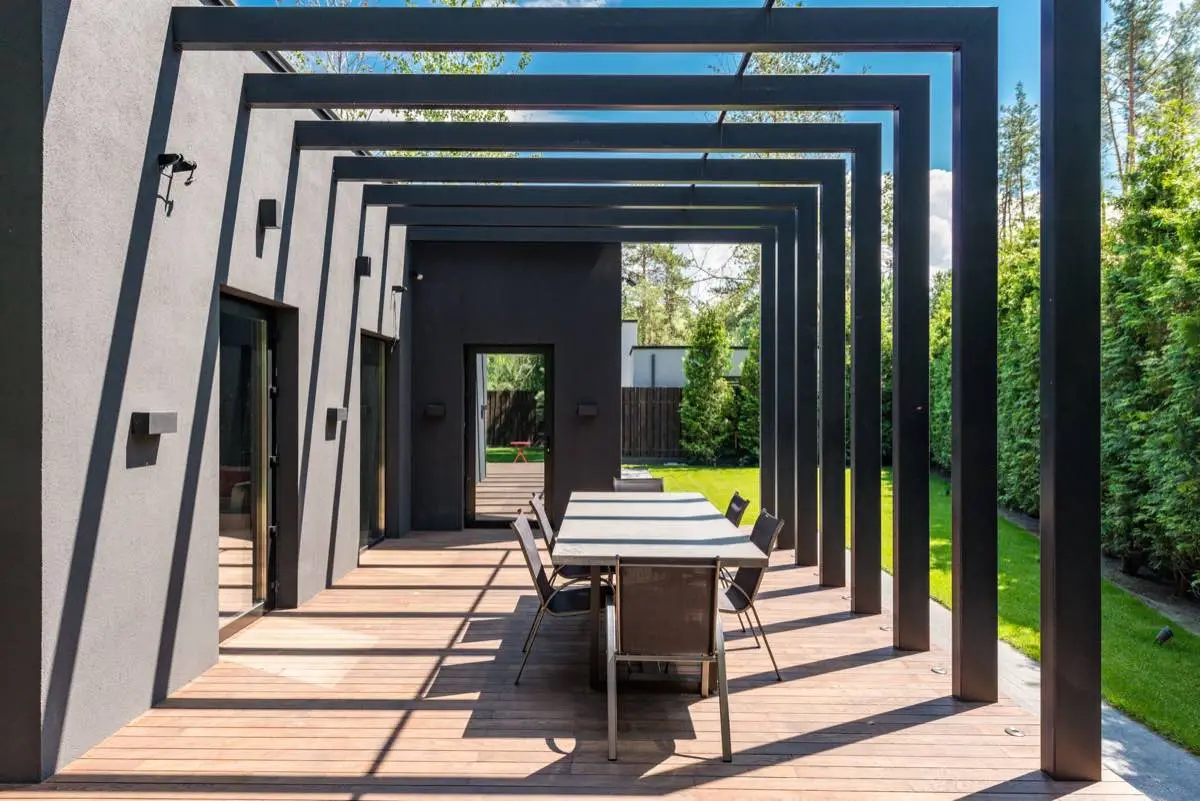
Insulated patio covers run roughly $30 to $60 per square foot installed, which puts a typical 12x20 somewhere around $7,000 to $14,000. A plain solid pan over the same slab runs about $20 to $40 a foot. So the insulation upgrade is real money, and this page exists to tell you when it's worth paying and when it very much isn't.
Fair warning: the word "insulated" gets stapled onto a lot of patio quotes by people who mean "it has a roof on it." A roof is shade. Insulation is a foam core sandwiched inside the panel doing physics. Those are different products at different prices, and knowing the difference is most of what you need here. For the broader material-by-material pricing picture, our patio cover cost breakdown covers everything from shade sails up.
What you're actually buying inside the panel
An insulated patio panel is two aluminum skins bonded to a rigid foam core, usually EPS or polystyrene. The skins are commonly 0.024 to 0.032 inch on residential work, either embossed with a wood-grain texture or left smooth. The core is where the money and the performance both live.
| Core thickness | Rough R-value | What it's for |
|---|---|---|
| 3 inch | ~R-11 to R-14 | The standard residential panel, most spans, most budgets |
| 4 inch | ~R-14 to R-19 | Longer clear spans, hot climates, recessed lighting |
| 6 inch | ~R-19 to R-24 | Long spans without beams, heaviest heat, premium builds |
The part nobody explains: you are usually buying thickness for the span, not for the R-value. A 6 inch panel isn't twice as comfortable as a 3 inch panel. It is, however, notably stiffer, which is how you get a clean 14-foot run with no intermediate beam cluttering up your ceiling. If your quote jumps from 3 inch to 6 inch, ask whether the reason is heat or structure. It's usually structure.
Cost per square foot, honestly ranged
Here is the pricing ladder as it actually exists, so you can place any quote you're holding:
- Aluminum lattice: roughly $15 to $30 per square foot installed. Shade, no rain protection.
- Solid or W-pan aluminum: roughly $20 to $40 per square foot. Full shade, full rain protection, no foam core.
- Insulated foam-core: roughly $30 to $60 per square foot. Everything the solid pan does, plus a real thermal break and a much quieter roof in rain.
- Louvered adjustable systems: $80 to $150-plus per square foot. Different product, different conversation.
Run those across a 12x20 patio (240 square feet) and it looks like this: lattice around $3,600 to $7,200, solid around $4,800 to $9,600, insulated around $7,200 to $14,400. Permits commonly add $150 to $800 on top, and a straightforward cover installs in 2 to 5 days once the permit is actually in your hand — the permit wait, commonly a couple of weeks to a couple of months, is the part of the schedule nobody enjoys.
What moves you inside the range
Two identical-size insulated covers can quote four thousand dollars apart, and it's rarely the salesperson being greedy. Usual suspects, in order of impact:
- Span and beam count. A clear span costs more than the same roof with a post in the middle. Sometimes dramatically more.
- Attached vs free-standing. Attached borrows the house for one side, so it's usually cheaper — unless your roof or stucco can't take a clean, properly flashed ledger, in which case free-standing is both safer and pricier.
- Wind and snow design loads. Your cover is engineered to a design wind speed under ASCE 7 as adopted locally, commonly in the 90 to 140 mph range and much higher in coastal high-velocity hurricane zones. Higher loads mean heavier posts, deeper footings, more anchors. In snow markets the load table does the same thing from the other direction.
- Footings. A typical post footing runs 12 to 24 inches across and 18 to 36 inches deep, deeper where frost depth demands it. Rock, roots, or a utility line in the way turns a two-hour dig into a day.
- Electrical. Recessed cans in a foam-core panel need the panel drilled and a wire chase run, which is why they cost more than a surface-mounted fixture. Plan lighting before the panels go on, not after.
The story every installer knows
It's the second week of a heat wave, you're standing on your uncovered slab holding a drink that went warm in four minutes, and you're doing quiet math about whether the good patio cover is worth it. That's usually the week the phone rings. The honest answer, given in the driveway more often than we'd like: if you're only out there once the sun's down, the foam core is money you will never feel.
When insulated is the wrong purchase
Say it plainly, because too few contractors will. Skip the insulated panel if:
- You use the patio mostly in the evenings. Lattice at roughly half the price does the same job for you, and you can put the difference into lighting and a fan.
- The cover sits out in the yard shading nothing but concrete. Insulation shines when it shades glass, a wall, or people at midday.
- Your budget forces you to shrink the footprint to afford it. A 12x20 solid cover beats a 10x12 insulated one for almost every household. Square footage is the upgrade you feel first.
Where insulated genuinely earns it: a west-facing patio that turns into a griddle at 3 p.m., a cover attached over a wall of glass, or any build with an outdoor kitchen or a TV underneath, where the ceiling temperature is the difference between a room and a carport with furniture in it. The foam core also cuts the rain drumming that makes an uninsulated pan sound like a snare solo.
The one opinion worth planting a flag on
Three inch foam-core is the sweet spot for most homes, and stepping to 6 inch for R-value alone is a poor trade. Going from roughly R-11 to roughly R-24 on an open-sided structure with air moving through it does not double your comfort — you are insulating a ceiling that has no walls under it. Buy the thicker panel when the span table says you need it. Otherwise put that same money into a bigger footprint, a proper insulated patio cover install with correct flashing, and a good fan. That combination beats a thicker panel every time.
Bottom line
Budget $30 to $60 a square foot for insulated, know that a big part of the price is span and engineering rather than foam, and be honest with yourself about when you'll actually be out there. If it's evenings only, a lattice or pergola structure is the smarter buy and we'll tell you so.
Pembroke Pines Elite Patio Covers builds insulated patio covers across Pembroke Pines and west Broward County, engineered to local wind and load requirements, with the panel thickness chosen off the span table instead of the upsell sheet. Free measure, itemized quote, and a straight answer about whether you need the foam at all. Call (844) 511-2320.
Ready for a free quote in Pembroke Pines?
Pembroke Pines Elite Patio Covers — free estimate, clear scope, no pressure. Use the form on this page or jump to the homepage quote.
Related services in Pembroke Pines
Pembroke Pines Elite Patio Covers money pages — go straight to the service you need.
- Insulated Patio Covers →
An insulated cover is a foam core bonded between two aluminum skins, spanning post to post with nothing underneath it. In a west Broward summer the foam is the difference between shade you stand in and shade you sit under for an hour.
- Lattice Patio Covers →
Between June and October it rains most afternoons here, and a lattice cover does nothing whatever about that. Start there, because more than half the people who ring us about one are picturing a roof.
- Outdoor Kitchens & Living Spaces →
An outdoor kitchen here gets used during exactly the hours the mosquitoes do. That one fact should shape the whole design.
- Screened Porches & Screen Rooms →
Ask anyone in Pembroke Pines what time they stop using the back yard and you will get the same answer: about the time the light goes. A screen room moves that boundary, and that is the entire value proposition.
- Patio Enclosures →
Most patio enclosures we build in Pembroke Pines are not built from nothing. There is already a slab, usually a cover, sometimes a twenty-year-old cage with two good walls left in it.
Frequently asked questions
How much does an insulated patio cover cost per square foot?
Insulated foam-core panels commonly run about $30 to $60 per square foot installed, versus roughly $20 to $40 for a standard non-insulated solid pan. On a 12x20 patio that's roughly $7,000 to $14,000 insulated against $4,000 to $9,000 uninsulated. Core thickness, span and skin finish move you inside that range.
What R-value does an insulated patio cover have?
Depending on core material and thickness, insulated patio panels generally land somewhere around R-11 to R-24. A 3 inch EPS core sits toward the low end, a 6 inch core toward the high end. Compare quoted R-values at the same thickness, because a thicker panel with a cheaper core can test lower than a thinner one with a better core.
Is an insulated patio cover worth the extra money?
It's worth it if you use the patio in midday heat, if the cover shades a window or a wall of the house, or if you're putting a kitchen or a TV under it. It is not worth it if you only sit out there after sunset — at that point you're paying for daytime performance you never collect.
How far can insulated patio panels span?
Foam-core panels span further than a flat pan because the core stiffens the assembly, and W-pan profiles do better still — commonly 8 to 14 feet unsupported depending on the manufacturer's load tables. The exact number depends on panel thickness plus your local wind and snow design loads, so it comes off the engineering, not off a brochure.
Does an insulated patio cover lower your air conditioning bill?
It can, but only if the cover shades glass or wall area that was previously baking in direct sun. Shading a west-facing slider is where the effect is real. Shading a slab in the middle of the yard does nothing for your indoor load, so don't buy the panel expecting the utility bill to pay for it.
What thickness insulated patio panel should I get?
Three inch is the common baseline and handles most residential spans. Step up to 4 or 6 inch when you need a longer clear span without extra beams, when you're hanging recessed lighting or a fan, or when you want the extra R-value in a hot climate. The thicker panel usually costs more for the span than for the insulation.
Can you add insulation to an existing patio cover?
Not usefully to a standard pan. You can add a rigid foam layer and a finished ceiling underneath, but by the time you've paid for framing, foam and a soffit, you're often close to the cost of replacing the deck with real foam-core panels that already carry the load.
Local context
How this applies in Pembroke Pines, FL
Every article here is written from patio cover work done in Pembroke Pines and west Broward County, so the numbers reflect local labour, permit and material costs rather than a national average. Your own job can land either side of them depending on access, the condition of what is already there, and the materials you pick — powder-coated extruded aluminum framing, 18x14 and no-see-um insect screen, screw-chase and snap-cover extrusions.
The way to turn any of this into a real answer is to have someone look at your actual situation. The free estimate is free, itemized and written down, with no deposit and no obligation. Call (844) 511-2320 or start on the Pembroke Pines Elite Patio Covers homepage.
Areas Pembroke Pines Elite Patio Covers covers
Pembroke Pines first, then the surrounding communities of west Broward County. Each has its own page with local detail rather than a copy of this one:
- Miramar, FL — Broward County, incorporated in 1955, population 134,721 at the 2020 census
- Cooper City, FL — Broward County, incorporated in 1959, population 35,301 at the 2020 census
- Davie, FL — Broward County, incorporated in 1961, population 105,691 at the 2020 census
- Weston, FL — Broward County, incorporated in 1996, population 68,107 at the 2020 census
- Southwest Ranches, FL — Broward County, incorporated in 2000, population 7,639 at the 2020 census
- Pembroke Park, FL — Broward County, incorporated in 1957, population 6,102 at the 2020 census
Or jump to the full list of Pembroke Pines services.
More from the Pembroke Pines Elite Patio Covers blog
- Patio Cover Permits in Pembroke Pines: What You Need
An attached patio cover almost always needs a permit. Here's what triggers one in Pembroke Pines, FL, what HOAs add on top, and what it costs to skip it.
- Patio Cover Lighting Ideas for Pembroke Pines Outdoor Rooms
Good patio cover lighting is three layers, not one bright fixture. How to plan cans, fans and low-voltage strings on a Pembroke Pines, FL patio.
- Outdoor Kitchen Patio Cover Planning for Pembroke Pines
Putting a grill under a patio cover is a clearance and ventilation problem first. How to plan it safely on a Pembroke Pines, FL patio, and what it costs.
The Pembroke Pines Elite Patio Covers Team
Licensed patio cover pros in Pembroke Pines, FL
Written by the Pembroke Pines Elite Patio Covers team — licensed, insured patio cover pros with 15+ years serving Pembroke Pines, FL and the surrounding area.